

The Negative Parallelism Tic
Head back to your social media feed, and you’ll see a familiar pattern: people filled with anecdotal ah-has. The post starts with a quick story, a moment where someone struggled to make something work. Then, they discovered the secret:
- For years I thought community meant proximity. Now I know it means being seen.
- Politics was never about winning arguments. It’s always been about who gets to be heard.
- We didn’t just build a tool. We built a community.
See these pop up, and you can nearly guarantee you’re looking at AI-generated content. These ah-has are really just a linguistic device that AI has been relying heavily on when producing content, but they didn’t start with chatbots. Negative parallelism, or the “It’s not A, it’s B” trope, shows up throughout history, whether in Martin Luther King Jr.’s dream that his children “will not be judged by the color of their skin, but by the content of their character,” or FDR’s assertion that “the only thing we have to fear is fear itself.” Like alliteration, this rhythmic structure can make for easy listening, but when used too often, it can make the message fall flat.
After talking with AI researchers, Will Oremus found that this tic of AI models could be traced back to the way they work through next-token prediction. Basically, when constructing a sentence, the AI looks for the most likely next phrase in a sequence. This makes “it’s not A, it’s B”, much easier than stringing together a sentence that explains the case for B. Now there could be other pieces to this. Once AI started doing it, future models training themselves off existing AI content or previous models could simply replicate the trend.
A Mirror for Human Cognition
It’s likely the models will evolve, and we’ll start to see this show up with less frequency. But if we think of AI models as attempts at mirroring and even evolving beyond human thought, this tic reveals not just a tic for AI, but a tic in our thinking more broadly. Deciding between two options is the easiest cognitive path: summer or winter, red or blue, for or against, rural or urban, good or evil. We can most easily describe what we are for by outlining what we are against.
The trick is that our politics has been hitting the “It’s not A, it’s B” button with increasing intensity long before AI emerged. Why? Because in the short-term, it produces votes, action, and investment. It catches our attention and makes it easy for us to comprehend how we could or should feel about complicated issues. The only trick is that, just like the AI trend, we soon start scrolling rather than engaging when we see the same tic repeated.
Long-Term Consequences
Many political scientists are eagerly trying to figure out how these voters will behave. Will they vote for democrats or republicans? But others are trying to get out of the same old “this or that” tic with unaffiliated voters. More in Common conducted a survey not based on who they’ll vote for, but on their hopes, fears, and concerns for the future. They gathered views of more than 8,000 people, a group of US citizens statistically representative of the population based on census data.
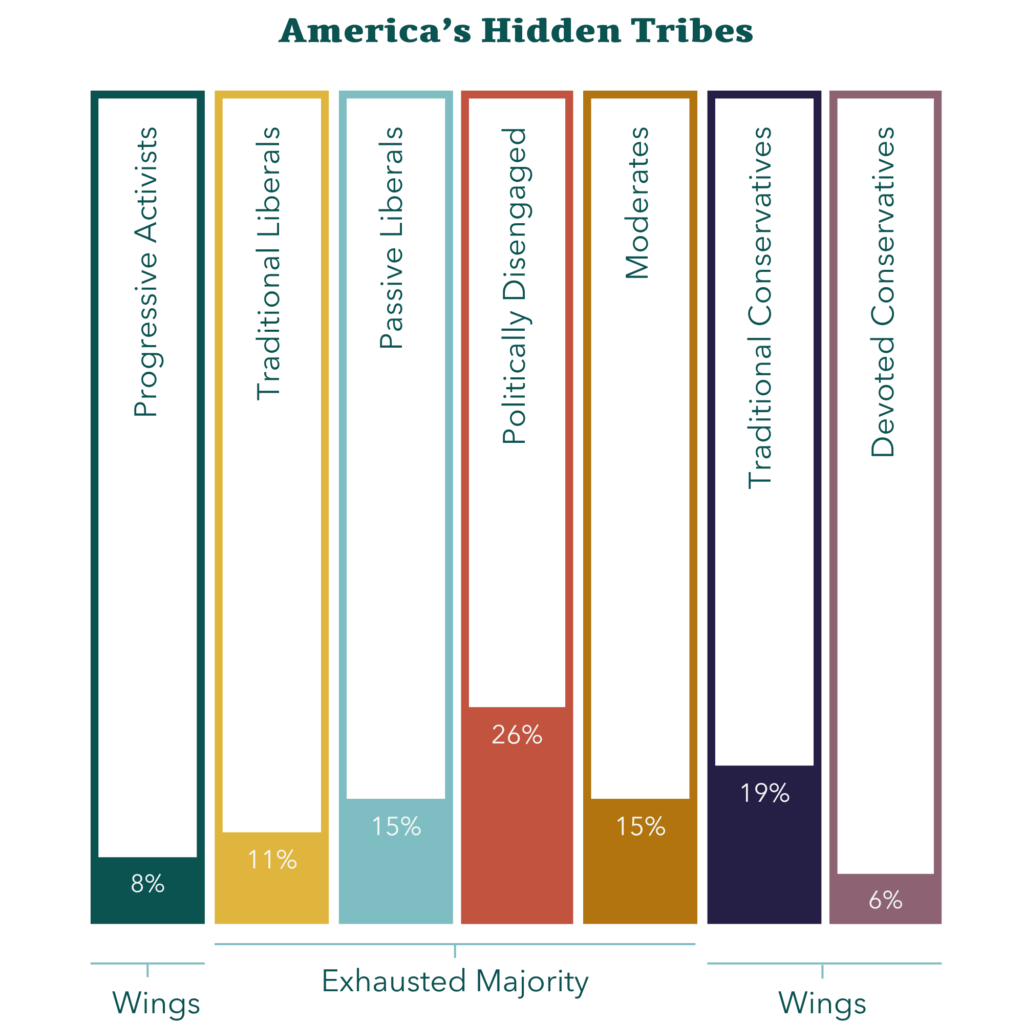
They found that across seven different belief groups, there exists an “exhausted majority.” While this group differs in its viewpoints, it agrees on a couple of key points:
- They are fed up with the polarization plaguing American government and society
- They are often forgotten in the public discourse, overlooked because their voices are seldom heard
- They are flexible in their views, willing to endorse different policies according to the precise situation rather than sticking ideologically to a single set of beliefs
- They believe we can find common ground
Time to Evolve Our Thinking
It’s entirely possible that by the time this article is posted, AI will have already figured out a way out of the negative parallelism crutch. The question is: can we?
While in graduate school, I taught public speaking courses to mostly freshmen (and the seniors who had avoided this 100-level course until their final year). There’s no doubt that many of my students dreaded public speaking in general, regardless of the type of speech. We’d start with the informational speech, where students had to educate others on a topic. Following that would be the persuasive speech, where students needed to convince their classmates of something. When we got to the invitational speech, this is where students across the board really got stumped. Not all public speaking classes have this speech. Based on the work of invitational rhetoric scholars Sonja K. Foss and Cindy Griffin, the invitational speech would require the speakers to explore at least three approaches to an issue. The point was to invite their audience to explore different perspectives and leave the listener to their own self-determination at the end.
The key to a successful invitational speech was to root it in values. Choose three values that were particularly important to any decisions on a given issue and explore solutions that would center each of those values. For example, how does an approach to solving hunger differ when we center:
- Affordability – ensuring food is available cheaply
- Nutrition and Wellness – ensuring everyone eats healthy food
- Self-Determination – ensuring everyone has the means to make their own food decisions
You may have felt your brain start to groan a little. Research on the paradox of choice shows that we want choices, but not too many. My wife loves adding shows to her favorites list, but when she craves something new to watch, she ends up finding something totally different rather than going back to the list because there are too many options. We should be mindful of turning up the dial on choices too quickly, but learning to think in threes instead of twos may be difficult for a while, simply because it’s new to us.
Moving from Two to Three
Whether our brains like it or not, our world increasingly demands that we explore more than two options.
Over the past year, we’ve been working on a project in Steamboat Springs, helping the community figure out what to do on a sticky housing question. After a piece of land was donated to the local housing authority to build affordable housing, the community voted not to move the land from the county to the city, where it could access the infrastructure needed to support a new neighborhood. After the vote, questions remained: did the community not want affordable housing at all, did they want it but not on that piece of land, or did they simply dislike the specific plan designed by the housing authority?
This vote has split the community apart, creating all sorts of assumptions about what someone who voted the other way thought and felt. To start rebuilding trust, we hosted small group conversations where at least two different groups were brought together to talk about possible approaches to the housing challenge. These didn’t have to be housing-specific groups. They could be a bowling league and a church group. They were asked to consider three different scenarios: what if our community:
- Focused only on building homes within our current city limits (known as infill)?
- Opted out of building homes in our city, but worked with other nearby communities to build housing?
- Built housing on the donated piece of land and brought it into the city?
At the end of these conversations, the vast majority of folks concluded that no single option would be sufficient to meet their housing needs or build the type of community they wanted to be a part of. Each had benefits. Each had trade-offs. This isn’t just true of housing.
Most of the issues we face are full of difficult choices. To narrow them down to “it’s not A, it’s B” assumes that we just don’t have the mental capacity to really think through the full set of choices. I believe we can, and others do too. That’s why the Council on Foundations just highlighted Steamboat’s work as an example of what it can look like to build bridges toward belonging. It’s possible that we, not just AI, can evolve.
Share this with someone who might appreciate that it’s not a or b, or even c, but something in between.