
Developing Civic Infrastructure at Scale
For over two decades, we’ve helped communities progress on pressing challenges—from early childhood development to food access, suicide prevention, health systems, and education—not by offering one-size-fits-all solutions, but by facilitating locally driven, cross-sector collaboration rooted in trust and shared learning.
Now, we’re scaling this work through the creation of regional civic hubs—community-rooted, nonpartisan, multi-issue platforms that can anchor long-term civic health. These hubs aren’t just conveners, they’re capacity builders, trained in facilitation, community engagement, and network weaving, with support from a statewide learning network. We offer leadership development, visioning tools, and hands-on coaching to ensure each hub can catalyze local action while contributing to regional and statewide solutions.
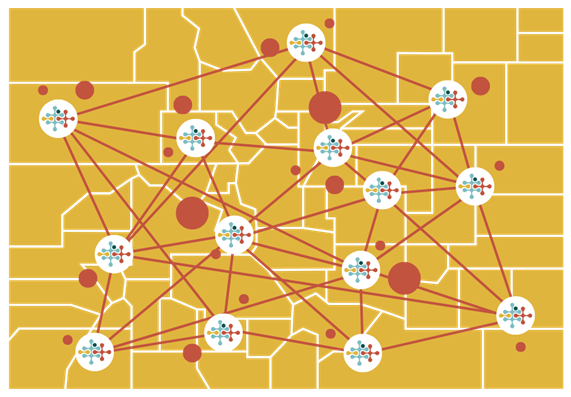
The path to a healthier democracy lies in nurturing civic culture within individual communities, and then letting that healthy civic culture emanate from these communities until it encompasses the entire nation.
Habits of Hearts and Minds: How to Fortify Civic Culture
Our Shared Challenge
It used to be that the most treasured resources of a society—its central spaces, tallest buildings, and most ornate monuments were celebrations of its institutions. Pyramids, cathedral spires, vaulted capital domes, and mirrored skyscrapers all pay tribute to the grand power of shared purpose and common practices.
But somewhere along the way, we’ve lost faith in institutions. Instead of building them up, we seem to spend more time tearing them down. From the work of DOGE in Washington to local Not In My Back Yard (NIMBY) resistance to affordable housing efforts, institutions are frequently seen by the left and the right as more suspicious than inspiring.
But sadly, as we tear down the institutions we blame for our woes, we lose our ability to solve the shared problems we actually face. As a result, the very infrastructure that holds up our communities—the roads, bridges, and buildings—is literally crumbling around us for lack of shared investment.
Even worse, the civic realm is suffering from a quieter decay. The town halls, local newspapers, trusted intermediaries, and cross-sector spaces that once anchored community life have all but disappeared. In their place, we face fragmented media ecosystems, polarized discourse, and decision-making processes that feel rigged before they begin.
Understanding Civic Hubs
As we noted at the outset, for all the reasons to bemoan our loss of civic infrastructure, the rise of civic hubs gives reason to hope. Seated at the intersection of several movements—e.g. the democracy movement, bridging and belonging, civic renewal—civic hubs are solution-oriented civic spaces that bring diverse perspectives together to make tangible change in their community. We utilize the metaphor of the Canopy to describe the role supportive networks can play in supporting the health of the collective. Individually, organizations can work to create a better world, like plants struggle to survive in direct sunlight. Alternatively, mature forests have the protective layer of a Canopy, a networked covering that can foster the health of everything growing below. We aim to create the Civic Canopy that supports our ability to create transformational changes for communities.
What is a Civic Hub?
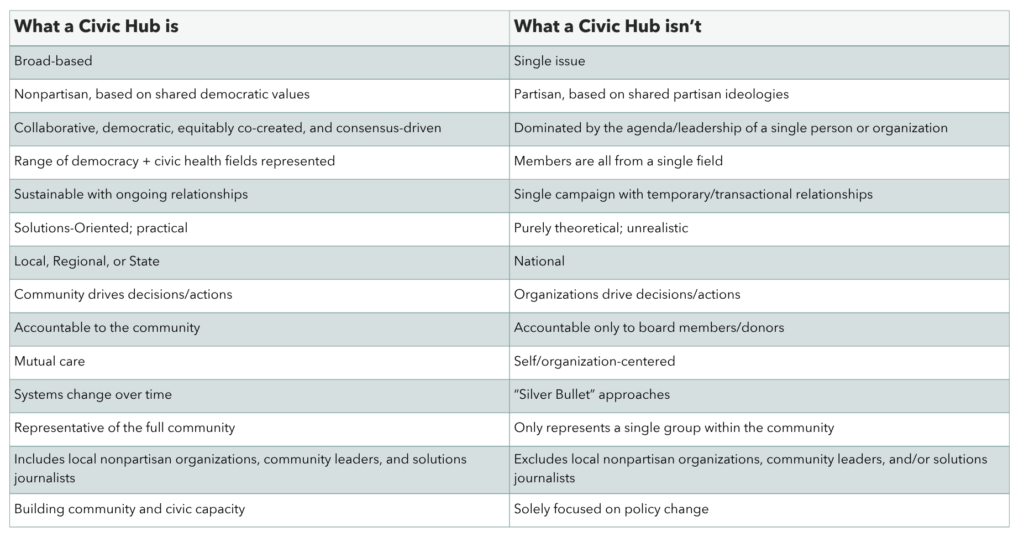
A Civic Hub is comprised of people or organizations from a geographical region which builds collective capacity. A Civic Hub is based on a shared vision and shared values, collaborative, and is responsive to the community in which it operates. Ideally, it is aimed at strengthening civic culture (not a single issue) and is cross-sector.
Better Together America, which has convened a network of civic hub builders across the country, including the Civic Canopy, defines a civic hub as “a diverse collection of local, nonpartisan organizations, community leaders, and solutions journalists who partner with their community to identify and solve its democracy and civic health-related needs, goals, and priorities together.” While they take different forms in different communities, they share a set of attributes that make them unique:
Support Services for Civic Hubs
To build a robust network of civic hubs, we will provide network stewardship through the facilitation of 4 convenings each year for participating hubs. Then, based on their stage of development, each participating Civic Hub will receive a tailored set of supports designed to operationalize trust-building, including:
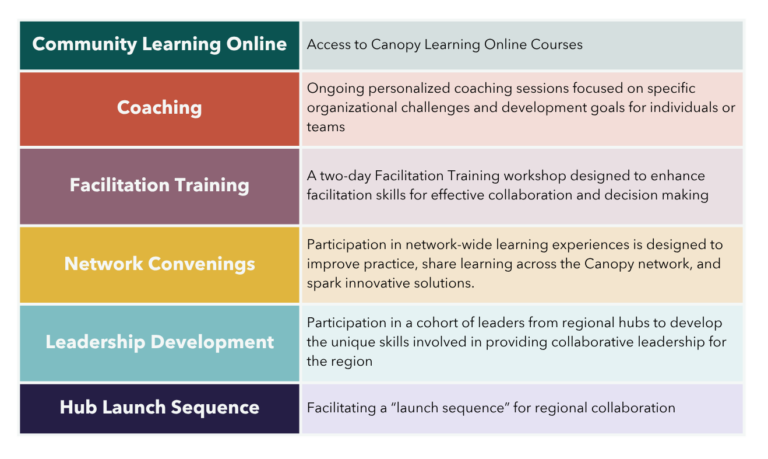
One example of a network convening currently gathering civic hubs with other civic innovators is the Colorado Civic Collaboratory. Based on Citizen University’s national program, the Colorado Civic Collaboratory is a mutual aid society where members can connect across identities and issue areas, circulate power and resources through mutual aid, and be inspired and renewed by other civic practitioners pushing for transformative change. Unlike other network convenings, the Civic Collaboratory combines both dialogue and action through its unique design.
Bridging Rural and Urban Colorado
The Colorado Civic Hub Network will begin with hubs in eight regions of Colorado, reflecting the state’s social, economic, and cultural diversity. These regions face different challenges—housing affordability, workforce transitions, rural isolation, growth pressures, institutional distrust—but they share a common need: the ability to work across differences to solve problems that no single organization or sector can address alone. Colorado mirrors national trends identified in recent Pew Research Center findings: while trust in national institutions and in “Americans in general” remains fragile, trust and optimism are notably stronger at the local level. People tend to believe in their neighbors and their communities, even amid broader polarization. This paradox underscores both the urgency and the opportunity of place-based trust-building. We truly believe that rebuilding trust in larger institutions must begin with grassroots efforts that build broader capacity and increased trust over time. This initiative treats Colorado as a living laboratory for trust-building, testing how local pools of trust can be cultivated and connected across geography, ideology, and identity. The diversity of participating hubs strengthens the initiative’s learning value, enabling us to identify patterns, adapt strategies, and generate insights with relevance well beyond the state.
Examples of Civic Hubs
Across Colorado, local leaders have been strengthening civic infrastructure in inspiring ways that embody the potential of civic hubs. Unify Montrose, for instance, has been holding civic assemblies over the past few years, bringing citizens together to address local issues collaboratively. Their approach demonstrates how community-driven dialogue can lead to meaningful, locally supported solutions.
Another great example is ChangeLine in Colorado Springs, which has evolved from the Community Health Partnership into a model of deep collaboration, tackling complex issues through sustained, cross-sector efforts. Their longstanding work underscores this approach’s impact on regional well-being and problem-solving.
Lastly, the NoCo Foundation has developed a shared vision for regional well-being through their Intersections report, showcasing how the power of convening at a regional level can help align diverse interests and foster a unified direction.