
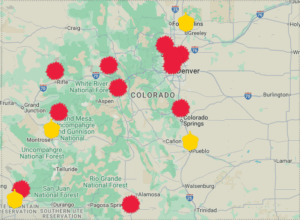
 Generation Wild is on a mission to rewild kids and get them to experience all the benefits Mother Nature provides. A whole network of coalitions across the state is breaking down barriers to getting youth and families outside. Beginning in Fall 2024, four new communities joined this network: Pueblo, Greeley, Montrose, and Ute Mountain Ute Tribe. These communities led a community engagement process to listen to what their community wants to see around opportunities to get outdoors. These groups were also tasked with bringing together community partners who may or may not have worked together previously to create a coalition with shared goals and strategies. The final product of the planning process was to develop a Final Report that includes an Operations Plan and a 5-year budget shared across Program Providers, which would act as their application for implementation funding starting in 2026.
The Civic Canopy has had the pleasure of working with three of these planning communities as they launch their coalitions, dive into community listening and research, and plan strategies to create equitable access to the outdoors. Even with nearly 20 years of experience supporting coalitions in every stage of development, there is always more to learn about what it takes to launch!
These emerging Generation Wild coalitions have been a ripe place for stories of what the launch of a collaborative effort can look like. Here are some of the lessons we’re watching unfold.
Get the Dance Moves Down to Improvise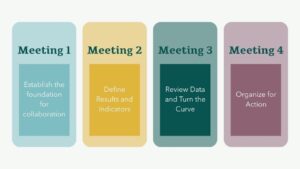
After nearly 20 years of launching coalitions, the Civic Canopy has the basic dance moves down. We call it the “Launch Sequence.” We typically ask a group to commit to a series of four three-hour meetings that move through establishing a shared vision, shared language, rigorous goal setting, and data-driven decision-making. It uses tools from a framework known as Results-Based Accountability (RBA), a disciplined process of moving from desired results to concrete action steps. RBA starts with the ends and works backwards to the means.
This Launch Sequence is a tried-and-true method…and…not every group will fit perfectly into these boxes. So, if you want to dance the Samba, you have to get the basic moves down. Then you can start to change the shape and form, speeding up in some places, and adding a twirl in others (I don’t actually know how to dance Samba, so I’m making some assumptions here).
For the Pueblo Generation Wild, this looked like holding two longer launch meetings while a smaller Core Team met more frequently to make strategic decisions and guide the process. An even smaller Planning Team met biweekly to keep track of all the details around community engagement, partner engagement, and coalition planning. At times, this got complicated as work was being done in many spaces at once, and the Civic Canopy played the role of connecting all these pieces. The stakes were made even higher by the fact that partners at the table had to agree on a plan for how to share resources through a 5-year collaborative budget for GOCO funding. To do this, it was necessary to have multiple spaces where conversations could be happening: coalition meetings, Core Team meetings, Planning team, program planning group, and individual conversations with program partners. In a sense, this was probably more like orchestrating a whole Samba flash mob.
For Greeley, the process started a bit later. So those same dance moves were compressed into about 1 month to make the deadline to apply for GOCO implementation funds. This means that a lot of the details for their plans will be filled in later. Both coalitions went through similar moves at different paces, and they will likely end up trying very different strategies. The Canopy has witnessed time and again the need for a high-quality process that is both replicable and customizable.
Targeted Universalism
Going from the Whole to a Part
As these Generation Wild groups went through the process of defining the results they wish to see in their communities, they can feel really broad, big, and even unattainable:
- All people in Greeley benefit from a connection to nature, their neighborhood, and each other.
- All families in Pueblo spend meaningful time outdoors.
- All youth in Pueblo grow up connected to nature and a strong sense of belonging to their community.
- Every person in Pueblo sees themselves reflected in the outdoor culture and acts as a generational steward of our outdoor spaces.
There was a moment at one of the Greeley launch meetings, where a few partners felt some discomfort with statements about “all people” or “all youth” when the express purpose of the coalition is to focus on the people who face the biggest barriers to accessing the outdoors. One participant expressed that it would be hard to see a result statement that didn’t include clear accountability for creating more access, specifically for East Greeley, the neighborhood the group is focused on.
Though it can be unsatisfying at times, the Canopy team invited the Greeley group to “trust the process enough” to see that we were setting a universal goal for a whole population and that we would address the question of “how do we get there” at the strategy level. These strategies would target groups that are uniquely situated within structures, cultures, and systems—for example, targeting specific low-income neighborhoods, focusing on BIPOC youth, and Spanish-speaking families. This framing is known as Targeted Universalism and can feel counterintuitive, especially for folks who are laser-focused on specific groups. The focus comes in at the strategy level, while we envision a world where all people can thrive.
In Pueblo, the coalition will focus its programming in an area referred to as the “Y-zone,” which includes the Eastside, Westside, and Bessemer neighborhoods, as well as Avondale in Pueblo County. It’s called the Y-zone because, similar to Denver’s “inverted L shape,” where you can see the geography of social inequality with the layers of race, class, pollution, education, and even shade from trees mapped onto a city. The histories here run a couple of centuries deep. So, when we practice setting goals with Targeted Universalism, it can bring up fear, resentment, and anger from many years of systemic neglect. No matter what meeting space we were in, there was a story we were combating of the city government, nonprofits, or other institutions “not doing anything” or “wasting resources,” or failing to fix the greatest problems folks are facing. For communities that have been surveyed over and over, studied, and promised change, the work of a new emerging coalition can be tough. These groups are wrestling with how to be both rigorous and realistic. Hopeful and accountable. The discomfort of an approach like Targeted Universalism is that it asks people to hold two truths at once: 1. It is possible to envision a future where we all thrive, and 2. There is a current reality that some of us are much further from thriving.
Backbones and Structure
The role of a “Backbone Organization” comes from the Collective Impact Model, which brings people together in a structured way to achieve social change. Setting up this structure is essential for guiding a coalition’s vision and strategy, supporting aligned activities, and establishing shared measurement practices. This is the kind of work that makes collaboration possible. It is also often invisible labor, with functions that can easily go under-resourced or unnoticed.
These Generation Wild groups had to wrestle with tough questions around how much to invest in the Backbone and how much to invest in program providers. The types of strategies that they will try will require both, and the balance of the scales will likely remain in motion over time.
In Greeley, this process was relatively straightforward, with the City of Greeley stepping up to be the Backbone and fiscal agent for the coalition. For Pueblo, it was a lot more complex. Pueblo had the luxury and the challenge of having many options to choose from. There were three eligible entities that the Core Team considered for the fiscal agency, and two strong organizations that were well suited to serve as the Backbone. The process of deciding on the structure required some messy, honest, and humble conversations that asked each representative to assess their own organization’s best fit for the future sustainability of the coalition. There were moments when the tug of competition showed up and pulled us towards a mindset of scarcity, but with a dedication to negotiation and dialogue, each organization sustained its commitment to the work of the coalition while taking on unique roles.