

Creativity and violence may feel like two words that don’t belong in the same sentence. But violence comes out of our reptilian brains when we’re assessing threats and moving quickly. This makes accessing creativity the antidote.
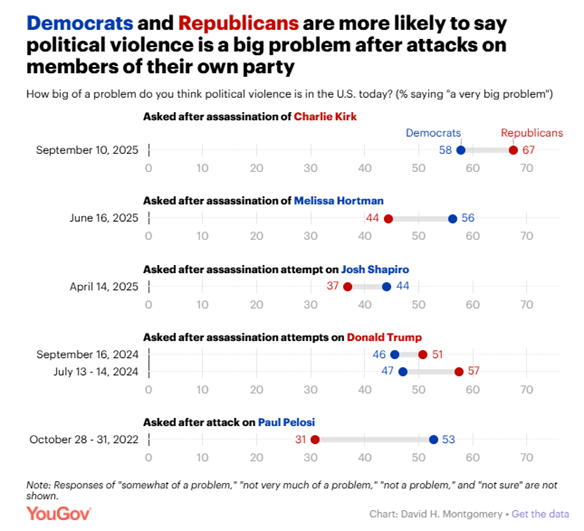
It was just six months ago that Charlie Kirk was shot in our neighboring state of Utah. But with the recent wave of headlines from Minneapolis, this feels like eons ago. Depending on your political beliefs, it’s very likely that you felt different when you received the news of each. Polling from YouGov shows that our perception of political violence and how big a problem it is changes depending on who is on the receiving end.
We recognize this incongruence, this mismatch of what people say they believe and what happens when push comes to shove, because we’re quick to point it out in the other. Especially on social media.
So, if we get stuck in only seeing the world we believe is true, what can help us imagine new worlds? I want to bring in two science fiction stories that can help us step into the world of possibilities
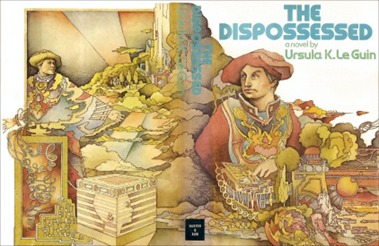
I’ve recently been reading The Dispossessed: An Ambiguous Utopia. It’s a 1974 science fiction novel by Ursula K. Le Guin. The book centers on Shevek, a physicist on an anarchist socialist planet, Annares. Here, no one knows the concept of owning property. All resources are shared. You check into your mess hall at night and get your portion. Anyone can choose any job they’d like, as long as there is a posting available.
Relationships are collective, not individual, so your children are not YOUR children, they’re OUR children. As a result, parents don’t rear their own young beyond an early age. Similarly, choosing a monogamous, committed partnership is the exception, not the rule. When one focuses too much on their own needs, people criticize them for “egoizing.” Shevek doesn’t feel like he totally belongs here. He’s chosen a committed partnership and hates sending his child back to the nursery at night. As a physicist, he’s also reached the limits of learning and seeks to learn from other worlds that may understand his complicated theories. He decides to do what no one else on his planet has done, return to their capitalist home world of Urras. On the one hand, this is the ultimate embodiment of their anarchist principles. That anyone is allowed to make their own choices, and no state or government can prevent that. But he does so knowing that if he returns, individuals on Annares will also be allowed to make their own choices, which may mean facing a mob when he returns that chooses to beat or even kill him.
In this imperfect Utopia, Ursula imagines how a group of people could design a world that manages two values that are often in tension: individual autonomy and the needs of the collective. This imagined world isn’t free of violence, but in a world that tries to protect our ability to engage in thoughtful argument as much as possible, it allows for the individual to step into combat when they think it’s needed. It’s also chosen to not allow immigration to try to protect their way of life. This may feel deeply at odds with the ideal of a socialist, anarchist society.

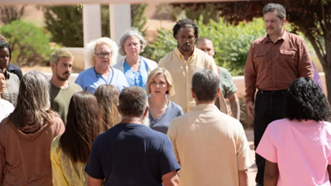
Contrast this with Pluribus, a show that came out on Apple TV in November. In the show, an alien virus begins infecting the earth, connecting each of its hosts with the previous. Each becomes linked into a collective hive mind where all their experiences, knowledge, and memories are shared.
There are just a handful of humans resistant to the virus, one of whom is Carol Sturka, an unhappy novelist whose wife is killed when the virus hits, causing her to shake and fall, hitting her head on the concrete. As a collective hive mind, the new human race is incredibly efficient. They turn the lights off at night in unison to reduce energy use. They eliminate the need for grocery stores by reorganizing supply chains and making sure everyone just gets the food they need. When Carol asks, they say they’re happy, a fact that infuriates Carol who finds their collective state robotic, unfeeling, and maybe even unhuman. In this world, combat does not exist because conflict does not exist. Unlike Annares, which wrestled with the tension between the individual and the collective, Pluribus eliminates the individual for a world without violence.
Just as I read Ursula’s work and sometimes scratch my head, saying that is definitely a 1970s way of thinking, the declaration’s signers were also imperfect science fiction writers. They were playing out what a democratic future could look like in 1776 based on stories from ancient Greece and the Iroquois Confederacy that they had never actually experienced.
I bring each of these not as a roadmap or recommendation, rather as a place to spark our thinking. As we reach the 250th anniversary of our declaration of independence and Colorado’s sesquicentennial (celebrating 150 years), we get to be our own authors. How creative do we want to be?