
Increasing Collaboration across Colorado
Learning Skills
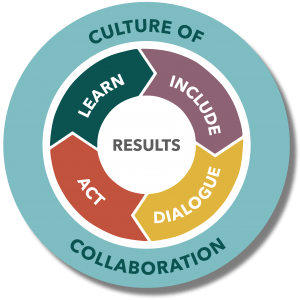
As a capacity-building nonprofit, our first aim is to help community members learn what it takes to create effective collaboration. We provide support across all areas of the Community Learning Model. Consistently, partners report significantly increasing their knowledge of what creates effective collaboration, including:
- How to engage diverse stakeholders
- How to foster dialogue
- How to take a results-based approach
- How to work with data
- How to reflect on past practices to improve future work
- What’s needed to take the next steps on your project
See how your collaboration skills compare.
Taking Action
After working with the Civic Canopy, partners take action. 80% of partners report taking action across the Community Learning Model, including:
- Act on the issue they were addressing
- Reflected on past practices to improve work
- Worked with data
- Take a results-based approach
- Fostered dialogue
- Engaged diverse stakeholders
Trusted Partners
Beyond that, partners trust Canopy to help them in the future. Partners rank their likelihood of recommending us at 9.1 out of 10.
Annual Report
Download our 2025 Year-End Recap.
Case Studies
See our work in action by exploring our case studies.

Laying the Foundation for the Future of Housing Through Community Voice
When designing a process for their 2024 strategic plan, Habitat for Humanity Vail Valley staff knew that they wanted to create a bold vision for the future of housing in their community. After all, their

Planning Through Play: A Collaborative Process in San Luis
Most people don’t like going to city planning meetings. But what if the planning could happen on a softball field? Photos by Teddy Leinbach In the small town of San Luis, the oldest municipality in
Elevar: Trusting Community to Lead the Way
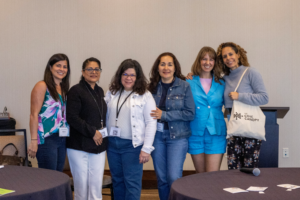
Pictured above: Members of Elevar’s Steering Committee alongside Eagle Valley Community Foundation Staff at the 2024 Civic Canopy Summit – Catalyzing Culture Change. It takes vision and conviction to challenge the current funding and grantmaking
“I've been impressed by the combination of talent and experience, but what really seems to be a root in care. They are concerned for the work, but also just the people they're working with. I think that combination is really powerful for building up a community.”
Past Partner
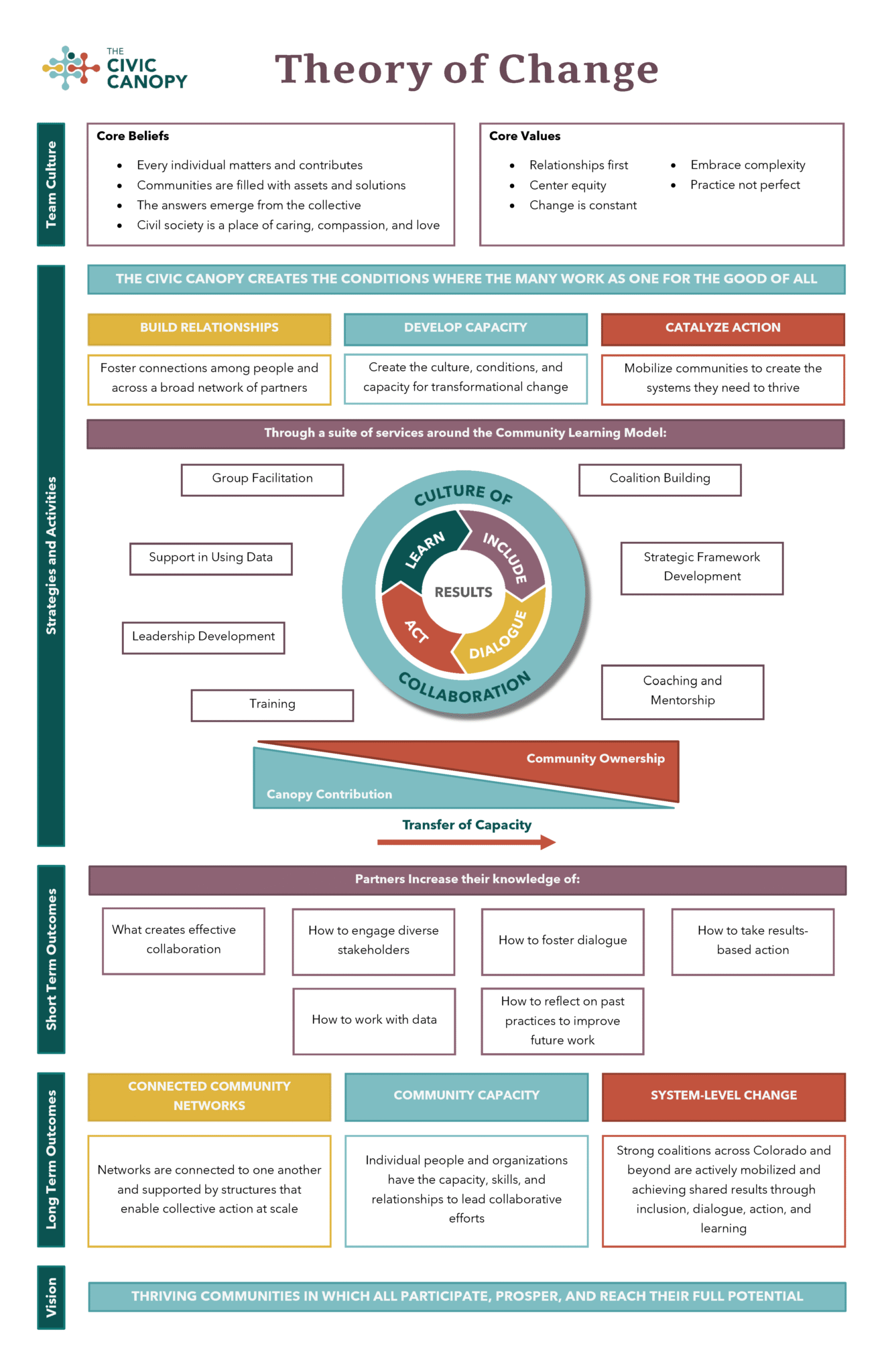
Theory of Change
“Yo lo recomendaría por que para nosotros fue una guía , un procesó de aprendizaje y el a eso a herramientas confiables , clara y en nuestro idioma.” “I would recommend it because for us [Canopy] was a guide, a learning process, and it provided reliable, clear tools in our language.”
Past Partner
Evaluating Impact
Each year, The Civic Canopy evaluates our work to understand impact and improve our practice. This summary covers three key insights gathered over the past year and the evidence to support these insights. These insights are based on data from a survey to evaluate long-term projects (Long Survey), a survey to evaluate one-time workshops/events (Short Survey), and a survey that evaluates the effectiveness of coalitions based on the Community Learning Model (CLM). We gather additional insights from interviews with partners 3-6 months after completing a project with the Canopy. We designed the evaluation tools to answer three Key Evaluation Questions based on our Theory of Change.
Key Evaluation Questions
- To what extent are The Civic Canopy’s key programming elements the right type to achieve their goals?
- Are the methods or training or technical assistance provided effective?
- To what extent are partners, clients, and communities better off, after applying the Knowledge, Skills, and Ability (KSA) taught by The Civic Canopy to increase their capacity and support to collaborate?
- To what extent do partners, clients, and communities apply the KSAs?
- Towards what end are clients applying KSA’s from The Civic Canopy?
- To what extent does The Civic Canopy effectively work with their partners?
- What are partner perceptions of The Civic Canopy?
Annual Reports
“Phenomenal facilitators and trusted thought partners. I felt in hard conversations like we could be transparent. That they would help us work through those challenging discussions and also sometimes just be that thought partner to bounce additional ideas off of in a less formal setting than a group facilitation.“
Past Partner